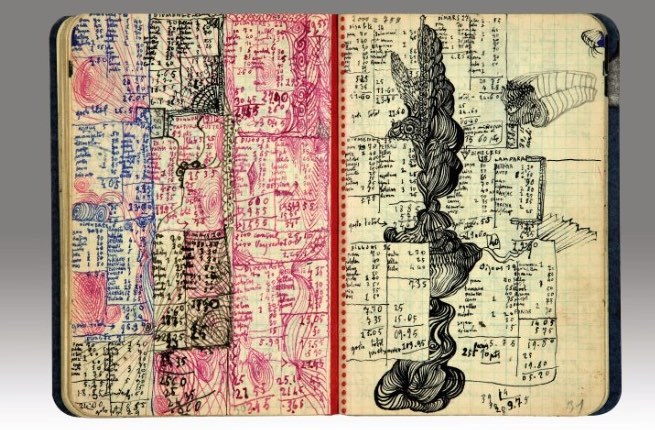
One of Salvador Dalí’s unpublished notebooks is up for auction at Sotheby’s in Paris. Part of a fantastic array of Dada and Surrealist items for sale by the Bibliothèque R. & B. L.
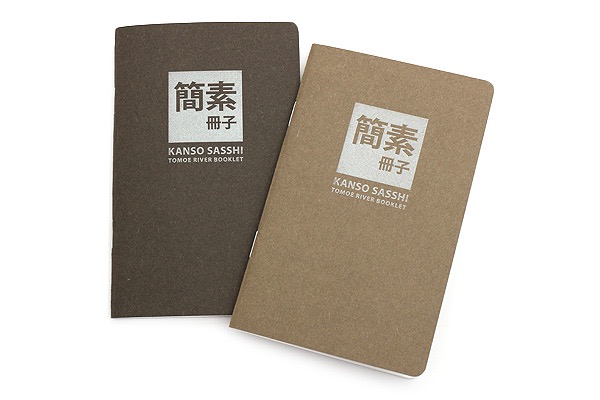
I recently purchased two new notebooks being offered by Jet Pens. As many already know, I’m a notebook addict and despite my lack of need can’t seem to stop buying and trying them. I’ve been a bit better lately but both of these came up and I could not resist them.
These are made exclusively for Jet Pens. What’s not to love about these? Ninety-six blank pages of Tomoe River paper with a handy lined insert card all in what has come to be known as the standard pocket notebook size. For people that care about good paper — especially those that use fountain pens — Tomoe River paper is the undisputed champ. Not only is the paper lovely to write on but it is super thin — with little show through — so a notebook can hold more pages in the same weight and thickness. For comparison, Field Notes Brand notebooks have only forty-eight pages in the same size book.
I give this one a “should buy”. To be honest, it will be hard for me not to switch to these once my current pocket notebook (MUJI A6) runs out. They’re that good.
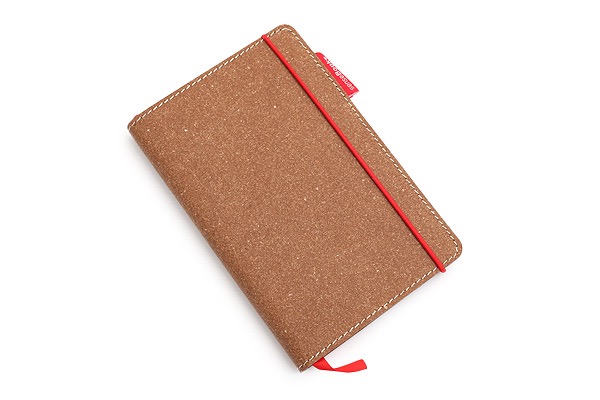
I really wanted (and tried) to like this one, but I just can’t. I kind of see what they were going for — something a bit more sophisticated than a small Moleskine. A leather cover, a better elastic closure, a nicer ribbon, numbered pages, and even a pre-printed index section at the front.
But, it is just so poorly manufactured it feels cheap. It is stitch bound — and in mine one of the stitches is already sticking up loose. It is stiff as heck and hard to keep open to use. A pocket-sized notebook should be easy to flip open and get to work. This is a struggle to keep open let alone lie anywhere near flat. I have to bend it back severely, a full 180, for several seconds and then tuck it under a couple of heavy objects on each side just to keep it open to transcribe this review. Perhaps such stiffness would improve over time and use but I would move on well before giving it a chance.
To say something positive, the paper is good. Not great, just good. It seems to take fountain pen ink OK and has a decent tooth to it. But, this is really me stretching to find just one nice thing to say.
Bottom line, avoid this one. Spend the extra $5 and get a pack of the Kanso Sasshi instead.
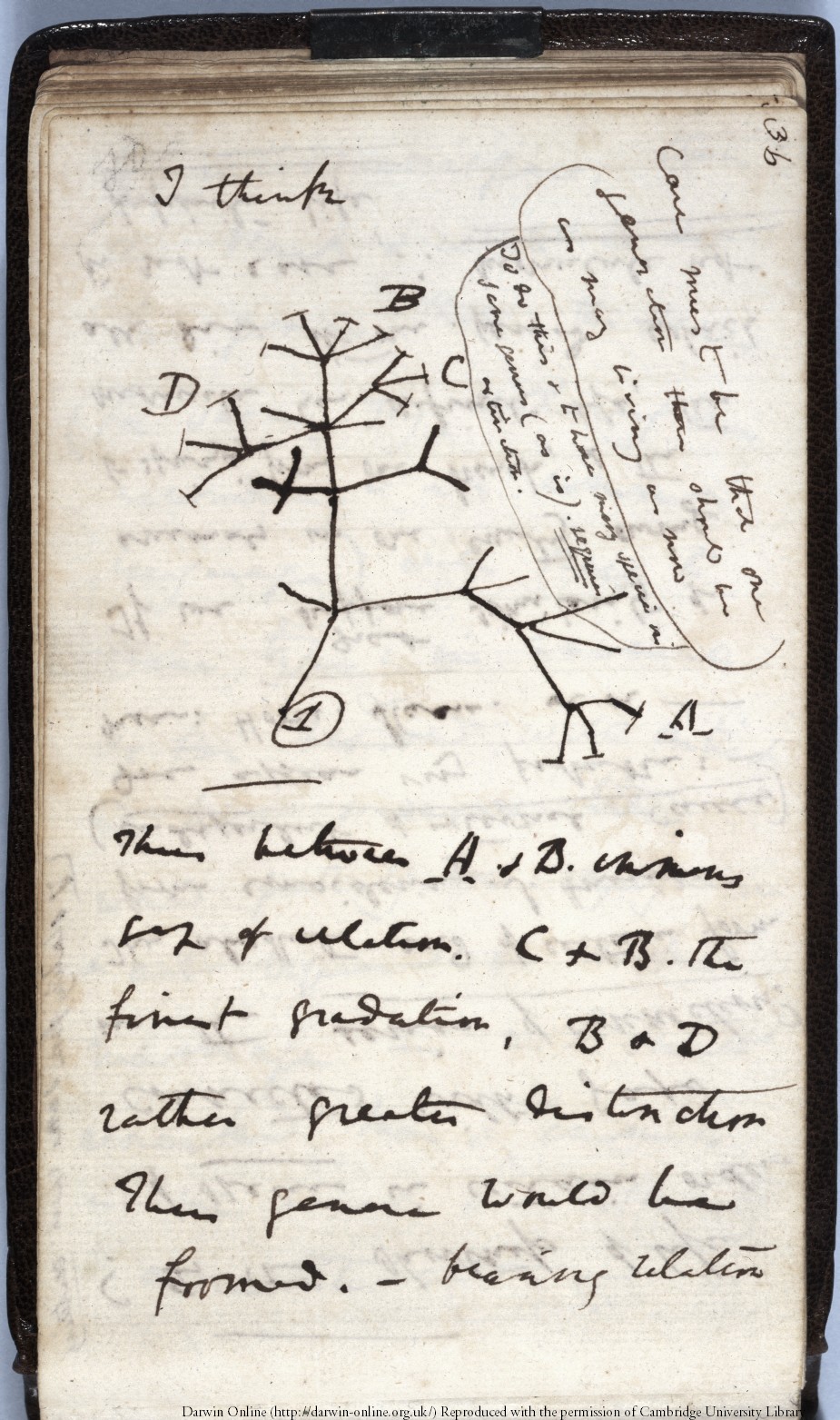
Case must be that one generation then should be as many living as now. To do this & to have many species in same genus (as is) requires extinction.
Thus between A & B immense gap of relation. C & B the finest gradation, B & D rather greater distinction. Thus genera would be formed. — bearing relation.
The notebook page where Charles Darwin first proposes the idea of evolution. A reminder that, like most breakthroughs, even the primary theory behind life on earth began with the seed of hesitation on a blank page.
For one thing, research shows that laptops and tablets have a tendency to be distracting — it’s so easy to click over to Facebook in that dull lecture. And a study has shown that the fact that you have to be slower when you take notes by hand is what makes it more useful in the long run.
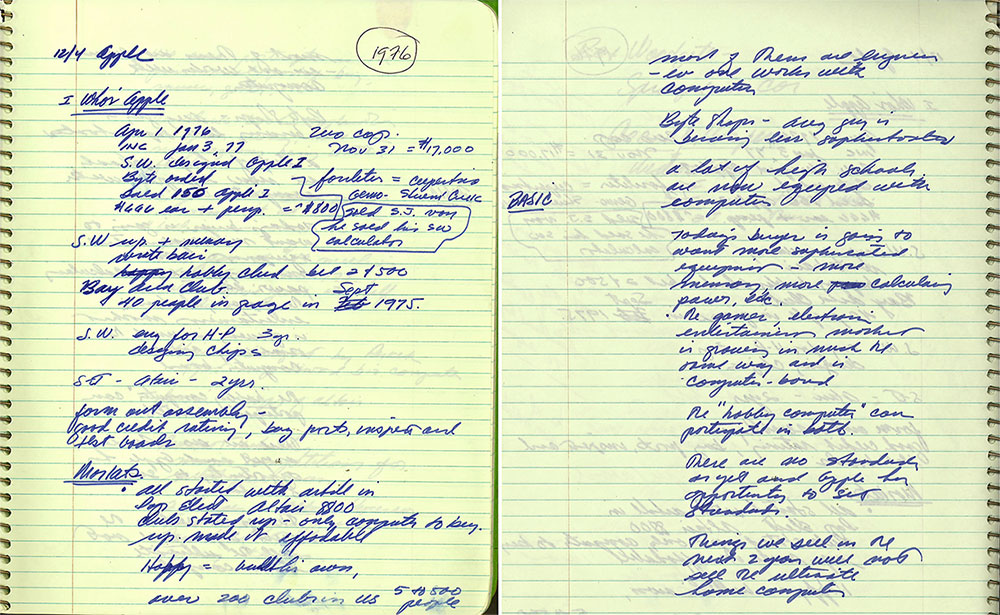
McKenna’s notes are in part a history of where Apple and the entire personal computing industry had been, and in part a blueprint for where they could go. In the most succinct possible fashion, he covered a lot of ground.
Fascinating stuff. Any fan of Apple or even the start of the personal computing revolution will find much to gawk at here.
It is a logical and efficient way for a small bookstore to expand its footprint, especially as big chains have shuttered locations, leaving a vacuum for enterprising independent stores to fill. A handful of independent stores around the country have taken the trade on the road, in an effort to stir up business and bring books to neighborhoods and suburbs without a bookstore. Little Shop of Stories, an independent store in Decatur, Ga., used a grant from the author James Patterson to turn a used school bus into a mobile bookstore. Fifth Dimension Books, a bookmobile in Austin, Tex., stocks a rotating selection of science fiction and fantasy books from its collection of 100,000 volumes.
Imagine if the Declaration [of Independence] were composed today. It would almost certainly be written on a computer screen rather than with ink and paper, and the edits would be made electronically, through email exchanges or a file shared on the Internet. If we were lucky, a modern-day Jefferson would turn on track-changes and print copies of the document as it progressed. We’d at least know who wrote what, even if the generic computer type lacked the expressiveness of handwriting. More likely, the digital file would come to be erased or rendered unreadable by changes in technical standards. We’d have the words, but the document itself would have little resonance.